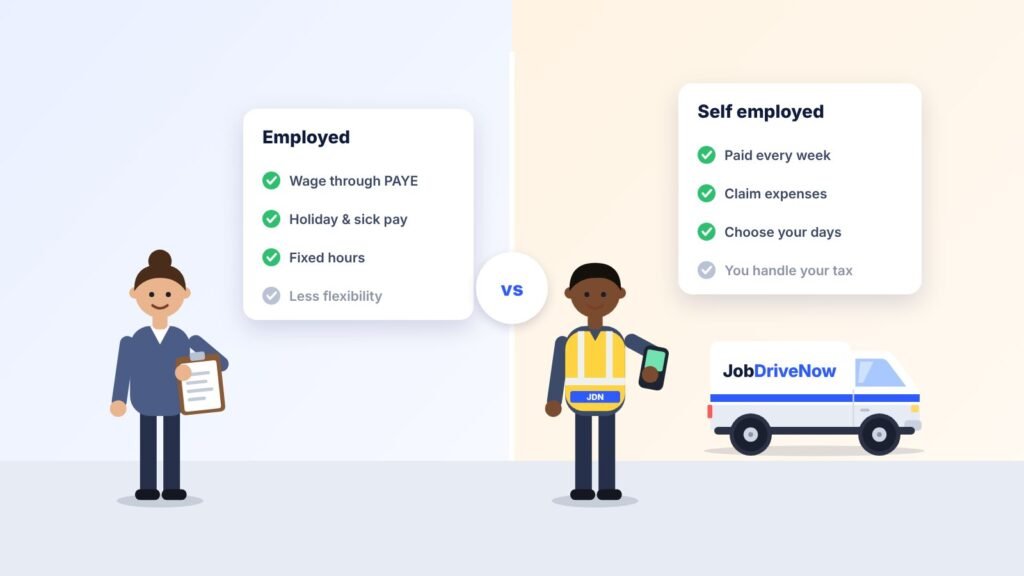
When you look at delivery driver jobs, you will see both employed and self employed roles. They can involve very similar work on the road, but the way you are paid, taxed and protected is very different. Here is a straightforward comparison to help you choose. This is general information — for advice about your own situation, speak to an accountant or check GOV.UK.
The short version
- Employed drivers get a wage through PAYE, holiday pay and sick pay, but usually less flexibility and a lower headline rate.
- Self employed drivers run their own small business, are usually paid a higher day or parcel rate, and can claim expenses — but they handle their own tax and do not get holiday or sick pay.
Pay
Employed drivers are paid an hourly rate or salary, with tax and National Insurance taken off before the money reaches their bank. Self employed drivers are paid a gross rate per day, per parcel or per week. That rate is usually higher because it has to cover your costs, your tax and the time you take off.
Tax and National Insurance
As a self employed driver you register with HMRC, keep records and file a tax return each year. You pay Income Tax and Class 4 National Insurance on your profits — your income minus allowable expenses. From April 2026, if your turnover is over £50,000, you also need to follow Making Tax Digital rules. See our Making Tax Digital guide.
Expenses
This is one of the biggest differences. Self employed drivers can deduct allowable business costs — fuel, van costs, insurance, phone, work clothing — before tax is worked out. Employed drivers generally cannot.
Flexibility
Self employment gives you more control over the work you accept and the days you work. Employment gives you a fixed contract and set hours.
Holidays and sick pay
Employees are entitled to paid holiday and statutory sick pay. Self employed drivers are not, so it is wise to build a buffer into your budget for time off.
Which is right for you?
Self employment usually suits drivers who:
- Want control over their schedule and the work they take on
- Are comfortable keeping simple records and putting money aside for tax
- Want to grow — for example by becoming an owner-driver or running more than one van
Employment may suit you better if you prefer a fixed wage, paid holiday and someone else handling your tax.
How jobdrivenow.co.uk supports self employed drivers
- Weekly payments with clear statements
- Regular rounds with predictable volumes
- Full training before your first day
- A recruitment team that can point you towards accountants and resources
Ready to start driving?
Browse rounds near you and apply online in a few minutes. Questions first? Our recruitment team is happy to help by phone, email or WhatsApp.
1 comment